Employees are increasingly using AI assistants to test ideas, summarise information, draft communications and think through commercial decisions. These exchanges may feel informal, more like private conversations than business records. In litigation or an investigation, however, prompts and responses can provide direct evidence of what a person knew, what options they considered and why a decision was made.
A Delaware Court of Chancery decision issued in March 2026 has shown how important this evidence can become. During June, legal commentators highlighted Fortis Advisors LLC v Krafton, Inc as an early example of AI chat logs entering the eDiscovery process and materially affecting the outcome of a case.
AI Chat Logs Became Key Evidence
The dispute arose from Krafton’s acquisition of video game developer Unknown Worlds Entertainment. The transaction included potential earnout payments of up to US$250 million. Unknown Worlds’ founders and chief executive also retained contractual rights to continue controlling the studio’s operations. After internal projections indicated that the planned release of Subnautica 2 could trigger most or all of the earnout, Krafton’s chief executive used ChatGPT to explore options for dealing with the payment and gaining control over the business.
The AI exchanges included a proposed “pressure and leverage package”, an implementation roadmap and the creation of an internal task force. Krafton’s subsequent conduct followed many of those recommendations. The Court relied on the AI exchanges as part of the evidence supporting its conclusion that Krafton’s stated reasons for removing the Unknown Worlds executives were pretextual.
It restored Ted Gill as chief executive with operational control and extended the earnout period to account for the period of his removal. Questions concerning monetary damages were reserved for the second phase of the proceeding. The judgment also records that Krafton’s chief executive admitted deleting specific, relevant ChatGPT logs.
AI Conversations Are a New Source of Evidence
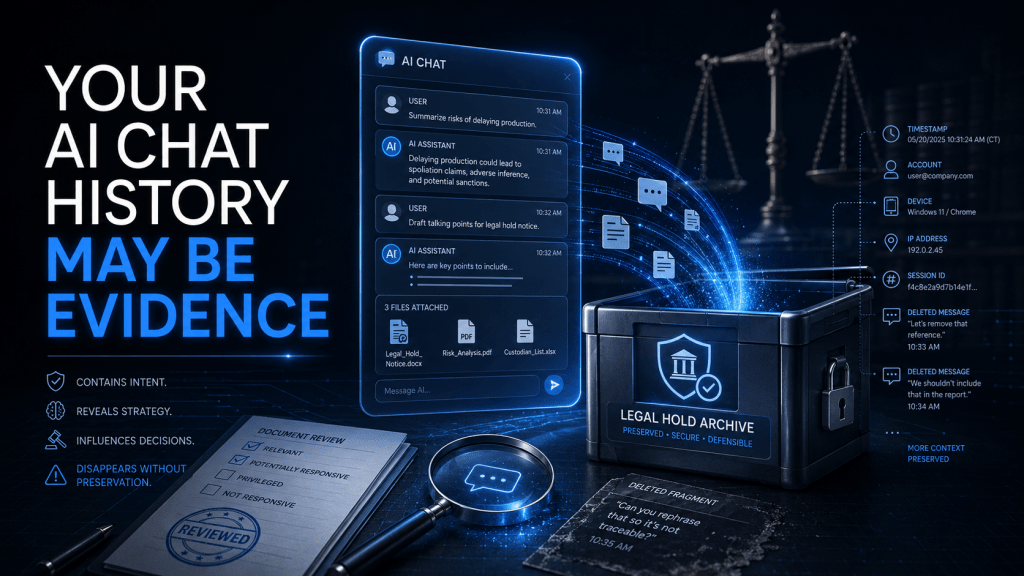
AI chat histories can contain information that does not appear anywhere else. A user may describe a problem in unusually direct terms, ask the system to compare different strategies or provide background facts that were never included in a formal document.
The resulting history may show:
- what information was available to the user;
- which options were considered;
- the commercial purpose behind a decision;
- concerns about legal or financial consequences;
- draft communications and proposed explanations;
- instructions intended for colleagues; and
- changes in strategy as events developed.
The AI response itself may sometimes be less important than the prompt. A prompt records what the user chose to tell the system and what they wanted help achieving.
Legal Holds Need to Cover More Than Email and Teams
The decision does not create a universal rule for how AI records must be preserved. It does, however, demonstrate why legal teams should assess AI content when defining the scope of a legal hold. Traditional legal holds commonly identify email, Microsoft Teams, mobile messages, shared drives and business applications. That list may now be incomplete.
Where AI use could be relevant, legal teams should establish:
- which AI tools key custodians use;
- whether accounts are personal or organisation-managed;
- whether users sign in through corporate credentials;
- whether chat history is enabled;
- how long prompts and outputs are retained;
- whether administrators can export or preserve records;
- whether users have deleted relevant conversations; and
- whether copies exist in documents, emails, screenshots or internal messages.
A legal-hold notice should not simply tell employees to preserve “AI records”. It should identify the relevant platforms and explain that prompts, responses, uploaded files, generated documents and related exports may need to be retained. Whether deleted records can be recovered will depend on the platform, account type, retention settings and how quickly preservation action is taken.
Custodian Interviews Should Ask About AI
The use of AI tools may not be obvious from an organisation’s usual data map. An employee may use a personal account from a work computer, access several different AI services or copy a useful response into another document without retaining the original conversation. Custodian interviews should therefore include direct questions about AI use.
Relevant questions may include:
- Did you use an AI assistant when considering this issue?
- Which platform and account did you use?
- Did you upload documents or paste business information into it?
- Did you share the results with anyone?
- Did you copy the response into another document or communication?
- Have any relevant conversations been deleted?
- Did the AI output influence the final decision?
These questions should be asked early, before accounts are closed, devices are replaced or platform retention periods expire.
Collection Requires Technical Planning
AI data should not be collected through screenshots alone where more complete information is available. A defensible collection may need to preserve the full conversation, timestamps, account details, uploaded files and surrounding context.
Depending on the platform, relevant evidence may be held within:
- the user’s AI account;
- an enterprise administration portal;
- browser history or cached data;
- a mobile application;
- downloaded exports;
- screenshots;
- emails or documents containing copied responses; or
- internal communications discussing the output.
The collection process should record what was searched, what could be exported, what was unavailable and whether any relevant data appeared to have been deleted. Review teams should also avoid treating every AI-generated response as factually reliable. The evidential value may lie in what the user asked and how they acted afterwards, not whether the chatbot’s advice was correct.
Why This Matters in New Zealand
The Delaware decision does not bind New Zealand courts, but the underlying evidential issue is directly relevant here. New Zealand organisations are already using generative AI for legal work, business analysis, investigations and eDiscovery. New Zealand Law Society guidance recognises these uses while emphasising the need for policies, confidentiality controls, privacy protections, vendor due diligence and human oversight.
New Zealand’s High Court Rules require parties to preserve potentially discoverable documents and may require disclosure of relevant documents that are or have been within a party’s control. Where AI conversations are relevant, legal teams should therefore assess them when planning preservation, discovery and investigation steps.
AI use should also be included in information-governance policies, litigation-readiness planning and the early scoping of important matters.
The Takeaway
AI conversations should no longer be treated as temporary or insignificant.
They may provide a detailed record of intent, strategy and decision-making. They may also become important evidence even when the user never expected anyone else to read them.
Legal teams should update legal-hold templates, custodian questionnaires and collection procedures so that relevant prompts, responses and uploaded material are identified before they disappear.
How We Can Help
We help legal teams and organisations identify, preserve and review emerging sources of digital evidence. This includes custodian scoping, cloud and device collections, preservation of AI chat histories where accessible, email and messaging collections, metadata analysis, eDiscovery processing, document review and the preparation of defensible evidence for litigation, investigations and regulatory matters.
Sources
Delaware Court of Chancery, Fortis Advisors LLC v Krafton, Inc
Baker Botts, A Video Game Lawsuit Shows How Discovery into AI Chat Logs Is Changing the Game
New Zealand Law Society, Generative AI Guidance for Lawyers
New Zealand Legislation, High Court Rules 2016: Discovery and Inspection

