
The EDRM model is a conceptual view of the e-discovery process. Phases do not necessarily flow in the order presented.
The EDRM model is an iterative process, where certain steps may be repeated numerous times, in order to identify a more precise set of results.
An eDiscovery process may also require revert back to earlier steps, in order to further refine the data as new information comes to light.
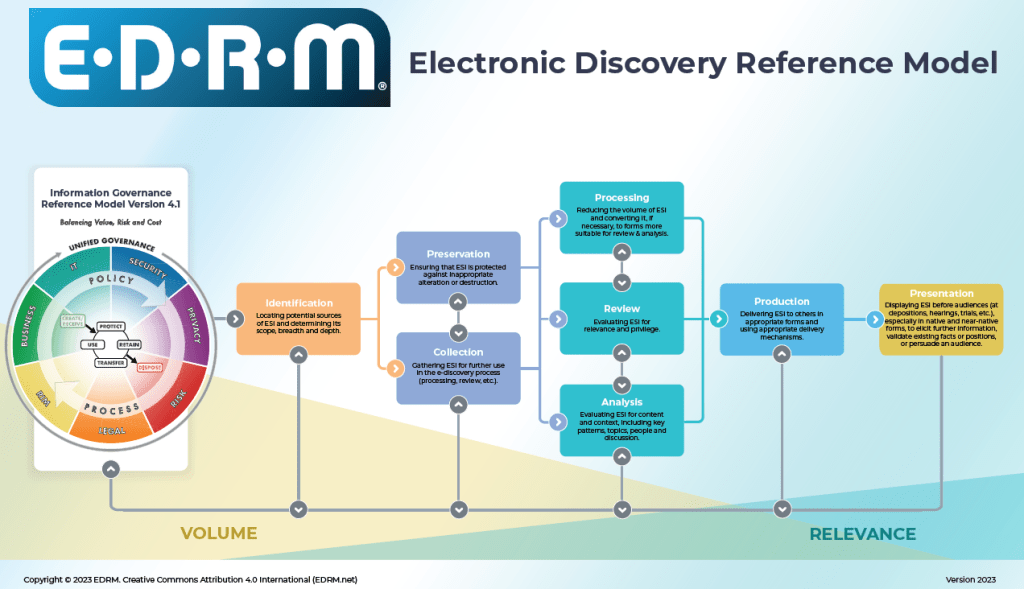
Source – https://www.edrm.net/edrm-model/current
Information Governance – Getting your electronic house in order to mitigate risk & expenses should e-discovery become an issue, from initial creation of ESI (electronically stored information) through its final disposition.
Identification – Locating potential sources of ESI & determining its scope, breadth & depth.
Preservation – Ensuring that ESI is protected against inappropriate alteration or destruction.
Collection – Gathering ESI for further use in the e-discovery process (processing, review, etc.).
Processing – Reducing the volume of ESI and converting it, if necessary, to forms more suitable for review & analysis.
Review – Evaluating ESI for relevance & privilege.
Analysis – Evaluating ESI for content & context, including key patterns, topics, people & discussion.
Production – Delivering ESI to others in appropriate forms & using appropriate delivery mechanisms.
Presentation – Displaying ESI before audiences (at depositions, hearings, trials, etc.), especially in native & near-native forms, to elicit further information, validate existing facts or positions, or persuade an audience.
 Forensic Tech